

I'm Steve — MiniWorkoutDad!
What Weight Should You Be Working Out At?
The number one question in my DMs and comments on Instagram is… how much weight? So let’s get to grips with the science and practicality of choosing your weight!
What’s the role of weight in the workout?

To figure out how much, you first need to know why we use a weight in the workout. The weight has three functions:
- To make the holds sufficiently challenging in 15 seconds
- To give us something sufficiently challenging to lift
- To make the cardiovascular demand sufficiently challenging over the workout
Do the holds without any weight and, perhaps with the exception of the squats, they won’t trouble your muscles.
The lifts are a breeze with…well nothing to lift!
And, you won’t get particularly out of breath performing this rugged “ballet” with just the weight of your own body.
So, the key criteria is “sufficiently challenging” in a each case. And, to know what that means, we need to understand what we are trying to achieve…
What’s the point of those lifts and holds?
Imagine your muscles are sandcastles on a beach, being washed away by the lapping tide. Time is that tide.
You perform the lifts and holds to maintain and/or increase the size of your muscles, against the tide of time.
Even though you are not a bodybuilder, you need to do this for health and longevity.
Starting as young as our thirties, you begin losing muscle to Sarcopenia. If this is news to you and you’re interested to know more, you can read all about it in “Age Healthier and Slower: The Scientific Proof for Resistance Workouts“.
Just in case you’re a woman and already thinking, “But, I don’t want to become bulky“; unless you take anabolic steriods at the same time, you won’t. You don’t have sufficient testosterone to look like a man.
In order to increase muscle size (so you can at least put back what you’re losing), you need to achieve a state called hypertrophy. There’s more on what’s sufficient to achieve that later on.

What’s the point of getting properly out of breath?
The word “cardio” is enough to raise a groan from many an older reader. Perhaps because in the 70s and 80s it became synonymous with burning calories.
The (daft) idea was you could eat more of what you want, if you were prepared to pound the pavements of your neighbourhood in your Nikes, burning it off. We now know better: you can’t exercise off a bad diet!
In recent times, the benefit of doing short but intense bursts of cardio has become more widely understood. So, instead of plodding, you need to be closer to sprinting (ideally uphill!). This has the benefit of:
- Raising your basal metabolic rate for an extended period (burning more calories)
- Pushing your cardio endurance to ever higher levels (making you fitter!)
I workout to be fit & strong for living, not for the mirror…
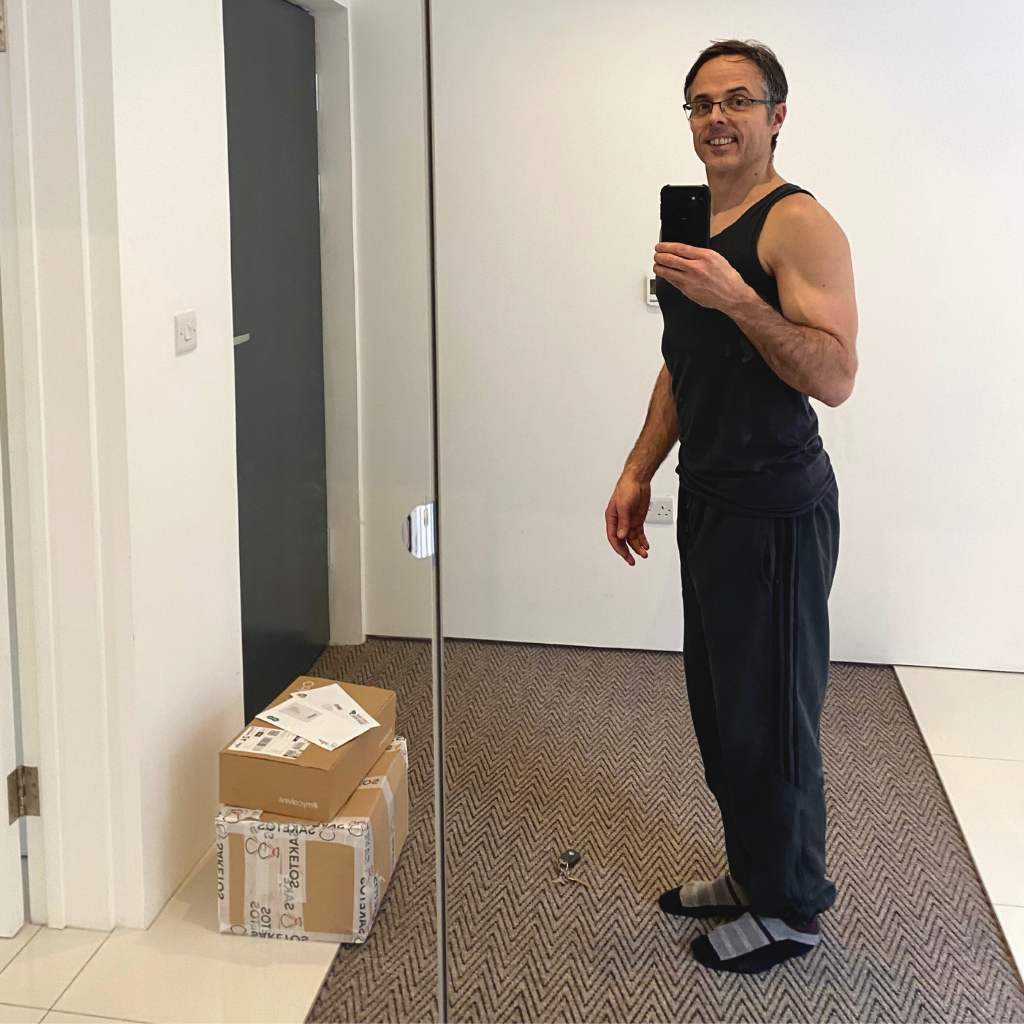
These 3 x 25-min workouts a week are all I need to build muscle & cardiovascular health.
Short intense cardio is what you’re trying to achieve doing my workout, so you need to be getting seriously out of breath and heading towards your heart rate max.
You aim for intensity, so you don’t need to go jogging for hours every week!
You can read more about this workout’s potential role in weight loss here.

How much weight do we need for the lifts and holds?
By far the biggest work element, based upon how long your muscles are working, are the holding exercises. Our holds are technically know as yielding isometrics and the science says…
“To increase muscle hypertrophy, IST should be performed at 70-75% of maximum voluntary contraction (MVC) with sustained contraction of 3-30 s per repetition, and total contraction duration of >80-150s per session for >36 sessions.”
Danny Lum, Tiago M Barbosa, International Journal of Sports Medicine 2019 [2]
This looks like a specification for muscle hypertrophy (growth), which is what you need.
You’re ticking the “sustained contraction” box at 15 secs per hold and, by rough approximation, the total contraction duration gets done in 6 cycles. So, if you work at 70% of your maximum strength/ Maximum Voluntary Contraction (MVC), you’ll be guaranteed results!
My bag currently weighs 60lb / 27.2kg and that feels pretty heavy in Phase 2 especially. If that is 70% of my MVC, that suggests the most I could hold momentarily is 86lbs/ 38.9kg, which seems plausible. I know that, after a couple of cycles, maintaining Phase 2 for 15 seconds becomes challenging – as does Phase 3 off the back of it.

Is it about weight or is it actually about effort?
Wait a minute though. In another study [3], additional “reps” at 50% MVC but done to failure were added to isometric training. The rest of the training was conducted at a higher 90% MVC for 5 second contractions. The additional reps added 1/6th to the overall training volume and were performed on one arm only. The arm that did not perform the additional to-failure reps achieved an average 0.6% increase in muscle cross sectional area (MCSA) over 6 weeks; the arm that did generated an average 11.3% increase in MCSA.
This study [3], separates hypertrophy from heaviness and introduces effort as the driving force. It suggests there is no magic weight (MVC %) to worry about, only how much effort you’re putting in.
Observations of effort
In the scientific studies, the percentages and timings are merely observations recording total effort. The difference in the second study was that the extra repetitions were done, not to a specified weight+time, but to absolute maximum effort (failure!). The muscles (biceps Brachii, Brachialis and Brachioradialis) were pushed to the limit of their capability.
This is what I mean, when I talk about working out with intensity. You must be struggling to maintain holds and make lifts as your workout progresses. Then you can be sure that you are pushing your limits and entering the zone where progress lies.
Intensity of effort is critical to progress — that’s why I always use the workout video…

It drives you on, keeps your technique tight, and prevents cheating on counts. More info here
So, what weight to start at?
I recommend doing a trial and error test on Phase 2 as the simplest way to figure out your starting weight.
The objective is to find the weight at which you can sustain Phase 2 (the Upper Front Isometric) for 30 seconds before failure. This should be your all out, arms shaking, effort.
Men should probably start testing weights from 15kg up; women from around 10kg.
Be sure to take 2 minute breaks between each attempt. If you don’t, you’re going to gradually exhaust the muscles and get a low test result.
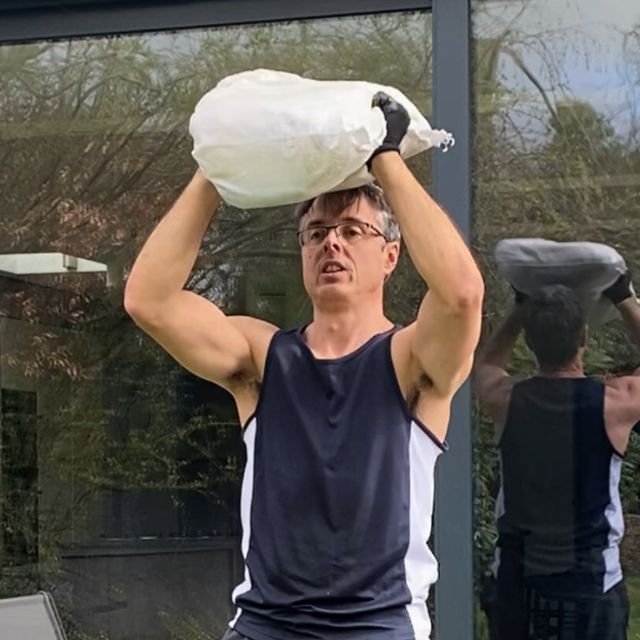
When you come to do your workout, that weight is going to feel pretty darn heavy, but that’s the point! You will be amazed how quickly you become accustomed to it.
But what about the lifts?
The lifts and transitions (lowering the weight) in the workout exercise your muscles over a full range of motion.
When doing the workout, you’ll notice that making the lifts becomes progressively challenging. This is because of a “chain of exhaustion” that’s occuring, where muscles are repeatedly hit isometrically at different muscles lengths and also in motion; eccentrically in the lifts and concentrically in the transitions.
The isometrics are the bulk of the work in the workout. They have the much larger role in exhausting the muscles. But, in doing so, they make lifting and lowering the weight far more challenging. This enables the lifts and transitions to have a bigger impact on our muscles at a lighter weight, as we push our limits. They are like the hard last rep, not the easy first one!
Need more help starting? Let me be your guide…
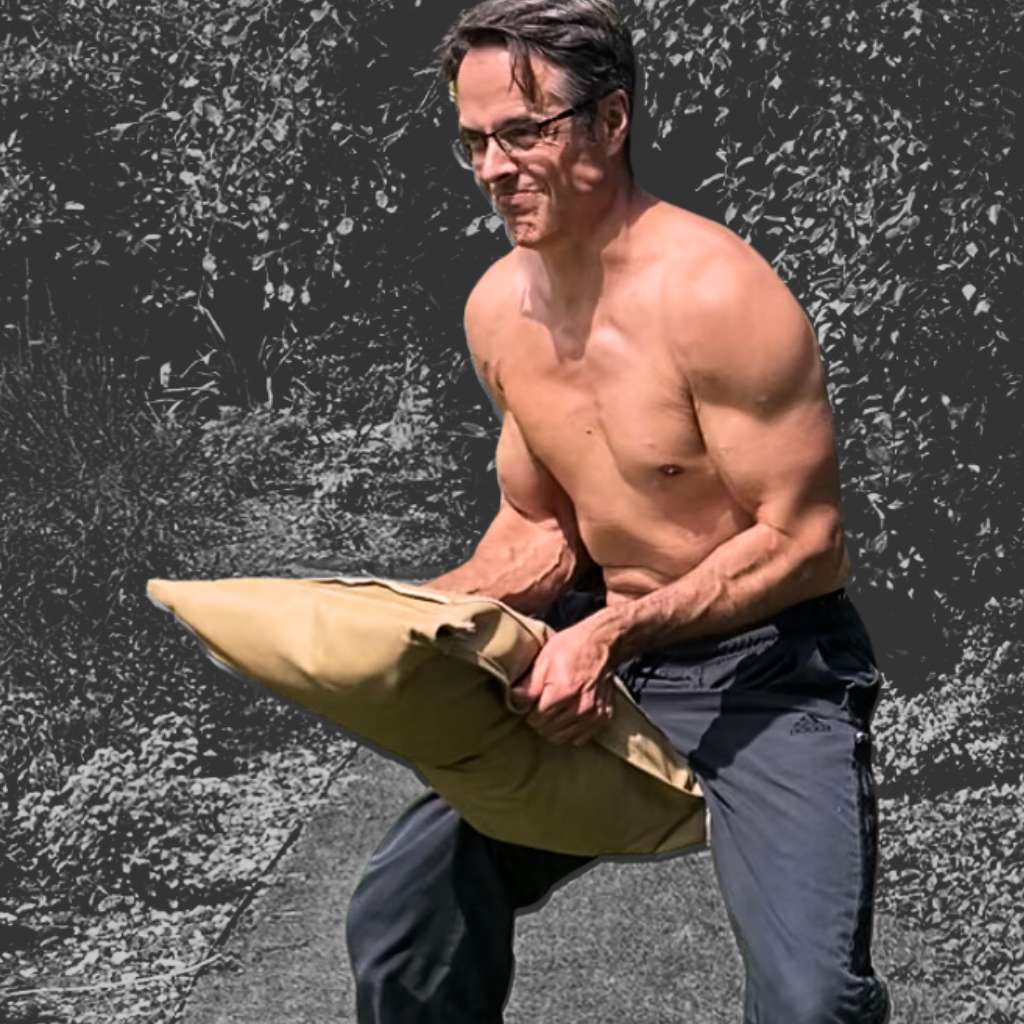
I’ve gone from zero to making 75-mins a week work. Let me help you do the same
How does cardio fit in?
Adding more weight, makes your muscles work harder. When your muscles work harder they need more oxygen. To get more oxygen, your lungs must process it into the blood faster and your heart must pump that blood more rapidly around the body. So, you breathe faster and more heavily and your heart rate speeds up!
The harder you make your workout on your muscles, the greater the demand on your cardiovascular system. By working out near the limits of your muscle’s capabilities, you can quickly reach Zone 3 (intense) cardio and easily achieve 95% of your maximum heart rate. At this level, you will be unable to complete 9 cycles without pausing for breath.
Just as your muscles develop when pushed to their limits, so does your cardiovascular endurance. You will get fitter.
In conclusion…

I’ve spent hours – days in total – pouring over scientific research reports looking for the magic numbers, only to discover what’s obvious, when you think about it. The only two things we really need to understand when choosing our workout weight are these:
- Your body only changes to adapt to greater demands and they can only be found at the edge of your current capabilities. If you’re not struggling, you’re not growing.
- 95% or more of what you do in your workout is laying the foundations, but you haven’t built anything until you do that toughest last 5% of effort.
Steve — MiniWorkoutDad

Get more info like this in the free Workout Success email bulletin!
References
1 – Chronic exercise preserves lean muscle mass in masters athletes. A.P. Wroblewski, F. Amati, M.A. Smiley, B. Goodpaster, V. Wright – The Physician and Sportsmedicine, September 2011
2 – Brief Review: Effects of Isometric Strength Training on Strength and Dynamic Performance. Danny Lum, Tiago M Barbosa – International Journal of Sports Medicine, May 2019
3 – Effects of Different Isometric Training Programs on Muscle Size and Function in the Elbow Flexors. ZhenFei Zou, Naoshi Morimoto, Miyuki Nakatani, Hirotsugu Morinaga, and Yohei Takai – International Journal of Environmental Research & Public Health, March 2023