I'm Steve — MiniWorkoutDad!
How To Bring Out The Big Guns Doing The Workout
Bulging biceps are built into my whole body workout, so you don’t need an extra “arm day”. Here’s how to grow yours faster, just by focusing on great workout technique!
Hold up, what about the Brachialis?
But, before we get into the workout, let’s take a moment to remember the unsung heroes of the arm and elbow flexion: the Brachialis & Brachioradialis muscles. Because, it’s these not-widely-known muscles that do a lot of the heavy lifting when bending your arm.

Your Brachialis is roughly 50% stronger than your biceps, but it’s hiding under them. It’s a shorter muscle connected to the upper (Humerus) and a lower arm bone (the Ulna), whereas the two bicep heads connect to the shoulder and either lower arm bone (the Ulna and Radius).
Your Brachioradialis is the muscle on the top of your forearm. It also connects to the Humerus and the Radius across the elbow joint. You can see it clearly in the Phase 3 photo (below).
Now, it’s easy to get tied-up in knots trying to separate out the contribution of these four muscles (there’s actually two biceps in each arm and sometimes even three!). But, since we’re not bodybuilders, it’s scarcely worth it.
Suffice to say they work together in different combinations and both the brachialis and biceps make up your “guns”. So, going forward, when I write “biceps”, I’m referring to the “layman’s biceps” which includes the Brachialis!

Tick every box in 25 minutes, 3 times a week Do the simple workout you can stick to and…
Find out moreIt all starts… at the start!
Phase 1 starts the workout and starts working your biceps. Think of it as the warm-up to those gruelling isometric holds.
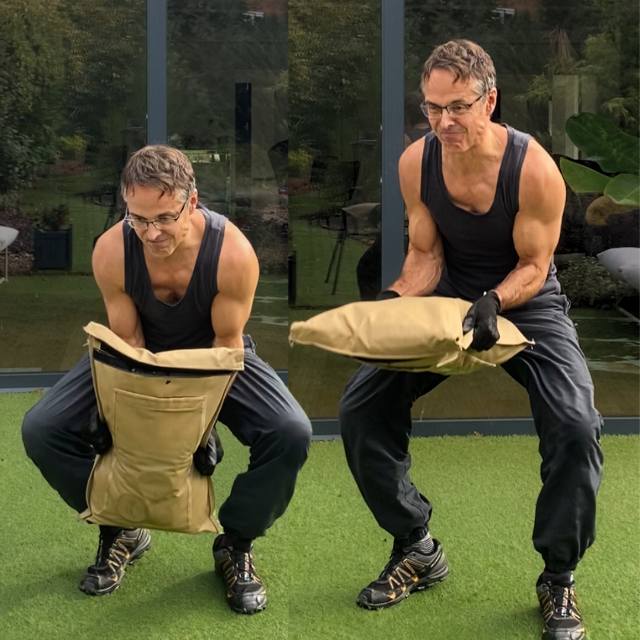
Your biceps are engaged from the very moment the weight is off the ground
You can see in the photos that two distinct movements should happen:
- You stand upright from a squatting position
- You pull the weight up and inwards using your arms only
As you rise from the squat, begin pulling the weight upwards and toward you using your biceps.

Use your biceps to pull the weight up and into your straightening body
To maximise the benefit on your biceps you need to:
- Drive straight-up with your legs
- Avoid using momentum to “snatch” or swing the weight upwards
- Avoid digging your elbows into your torso
- Hinge upright from the hips with a straight back
Once your hands are at shoulder height, your shoulder muscles, upper back and triceps take over to drive the weight over head. To do this, your biceps must release their contraction.
During the next phase (2), your biceps get a 15 second rest, because your triceps take the strain. They keep your arms bent and prevent the weight falling into your face!
Phase 3 lays the foundations of bicep building
Just over 50% agreed Phase 3 is the toughest of all in the workout, in my quick Instagram Story poll. It’s a hard grind. But, if you want bigger biceps, you need to meet the challenge.
Getting the biggest bicep benefit means keeping the technique strict, even when you’re struggling.
- Your arms should be free at your sides
- You make a ~90-degree angle at the elbow
- Keep your elbows away from your body, not dug into your torso.
- Stand upright (this hold is hugely beneficial to your abs/core and lower back)
- Pushing the weight up and away places your thumbs at chest height
In Phase 3, you hold the weight at most mechanical disadvantage: your forearm gives the weight maximum leverage and gravity is pulling straight downwards.

When you (finally!) exit Phase 3, allow your arms to straighten slowly, so you get an eccentric (negative) 1/2 rep!
No resting in Phase 4
Although Phase 4 is primarily for exercising the lats and supporting back muscles, your biceps aren’t fully rested. They play a supporting role in maintaining the bent elbow.
Phase 4 lowers the load, but changes the angle to about 65-degrees; your biceps are more contracted.
When doing Phase 4, it’s vital you pull your elbows upwards and back, rather than lifting your hands to your chest. If not, you will be working your biceps fully!
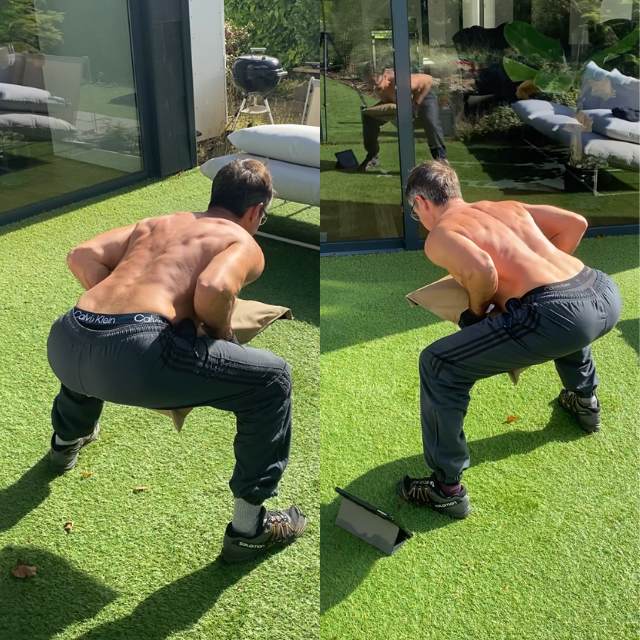
Limited action in Phase 5
We already have the weight pulled into our bodies, before we hinge to upright. But, the movement to upright transitions gravity’s pull onto your biceps. Your biceps have a small part to play in maintaining that hand position, briefly.
Are you squeezing in Phase 6?
I can almost hear the replies, “Heck no, those squats are hard enough”. And, to be honest, this is the most inconsistent part of my workout. I often forget the bicep squeeze! That means you can build biceps without it. But, you will squeeze a little extra out of your workout, if you get consistent about doing this contraction.
Phase 7 is all triceps, traps, shoulders and core, so it’s a wee break for your biceps.
Biceps back in action in Phase 8
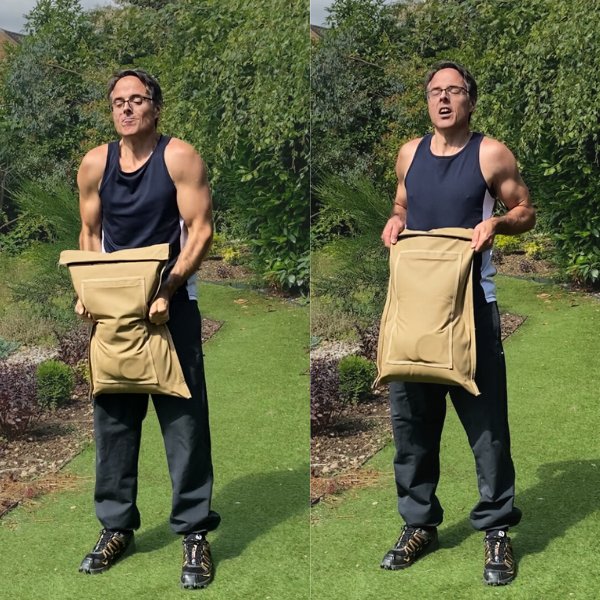
Again, Phase 8 is primarily a back exercise. It’s designed to address the imbalance between anterior and posterior muscles, that causes so many shoulder problems. But, because of how our bodies work, the biceps are back in action again!
We need bent arms to perform the shrug and the back squeezing hold that follows. That’s on the biceps.
You can see that the angle of the arm changes, between the shrug and the hold.
Having your hands just above belly button level in the hold, means you’re exercising the muscle at a tighter angle and shorter muscle length than Phase 3. That’s a good variation.
Try to resist the temptation to lean back, as this lessens the load on your arms and back.
The final test for your biceps…
The last thing your biceps have to do is help heave that weight onto your shoulder, so you can do your lunges. They’re pretty exhausted by now, so it’s a tough final challenge!
If you need to put your weight down and adjust your grip, that’s fine – just be sure to bend your knees.
Once your grip is good, lift the bag from waist height onto one shoulder, using only your arms. Stand firm, try not to lean back and don’t kind of ‘sling’ it up there. The more control you exert, the more benefit you’ll get out of this lift!

Capability first
So, I hope you found this useful and picked up some extra tips?!
If you keep doing your workout consistently, you will notice your biceps are making a bigger impression. And, that’s a happy bonus of being physically more capable too.
Steve — MiniWorkoutDad
Get more info like this in the free Workout Success email bulletin!