

I'm Steve — MiniWorkoutDad!
Exploding the Myth Isometric Exercises Don’t Build Muscle
There’s a popular myth on the web and social media that isometric (holding) exercises won’t build muscle. Let’s explode that with scientific proof…
How do we know that these tough holds are actually achieving anything?
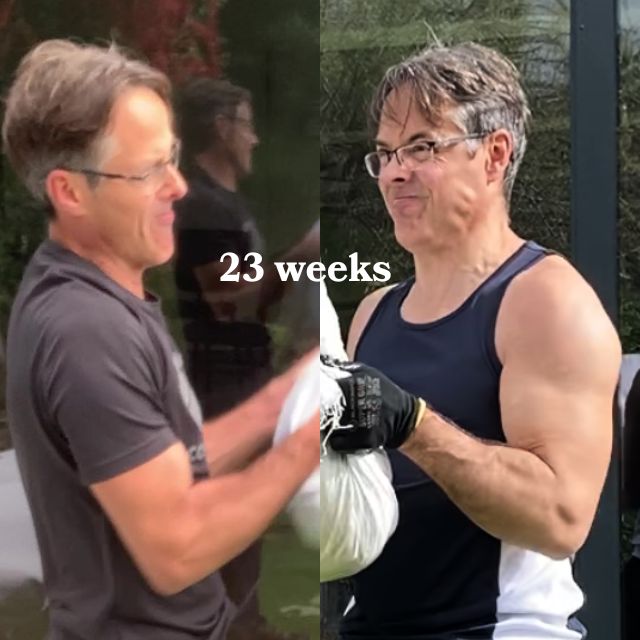
I know from the changes to my own body over the past 10 months that isometric exercises build muscle.
But, you will read on popular health websites and on social media that they don’t.
Or, that they don’t work very well.

So, in this article, I’m going to debunk the myth that you’d be better off “repping out” with dumbbells than doing our workout.
The scientific proof isometric exercises do build muscle and very effectively:
A 2003 study[1], set out to objectively evaluate the relative effectiveness of isometric, eccentric (muscle shortening) or concentric (negative rep) training modes for inducing compensatory hypertrophy (stimulating muscle growth).
They found isometrics to be one of the most effective training modes:
- Isometric exercise increased muscle mass more (14%) than eccentric (12%) or concentric (11%) exercises
- Isometric exercise produced similar increases in total muscle DNA and RNA to eccentric or concentric movement
- Isometric and eccentric training resulted in increased muscle insulin-like growth factor I mRNA levels
They used a rat model with electrically stimulated (sciatic nerve) contractions. This provides a highly-controlled test situation, that better isolates the effect of the training. Human subjects cannot be immobilised for 20 days like the rats!
This study proves isometrics is just as effective as putting in the “reps”, even when measured at a molecular level.
But, what about in humans I hear you cry!
I accept that we are no more than intelligent mammals, and that it’s highly unlikely results in human subjects would differ significantly (if only we could strap some down).
If you don’t, science has proof of the effectiveness of isometrics in humans as well – even older ones!
In 1996, changes in strength, speed and size of the quadriceps muscle were investigated in elderly men and women (average age almost 72) after 6 months of isometric strength training[2].
In this study, one leg was trained using continuous isometric contractions (CC) and one using short intermittent isometric contractions (IC)
Tick every box in 25 minutes, 3 times a week Do the simple workout you can stick to and…
Find out moreThis 1996 quadriceps study found:
- CC isometrics increased quadriceps strength by 53.1% and IC by 48.3% over the 6 months.
- Increases in muscle (and bone) cross-sectional area of 4.0% for CC and 4.9% for IC protocols were observed. These increases were significantly different from the decrease observed in the control group.

Note that the control group, who didn’t follow any training protocol, continued to lose muscle due to sarcopenia!
But, that’s just one study!
Okay, here’s another…
A 1992 study of university-age females[3], proved isometrics is effective at making bigger, stronger muscles. This study, used 8 weeks of isometric training on one leg only and a control group. It reported:
- Cross-sectional area increases of 14.6% of the trained leg.
- Maximal voluntary contraction (strength) increases of 28% of the trained leg.
The same measures in the untrained legs of the experimental subjects and in both legs of the control subjects were unchanged.
You need more proof?
If you want more evidence that isometric training builds muscle, you find plenty using Google. But, why not create your own evidence instead?
If you do the workout consistently and with intensity, you will get stronger and increase your muscle mass. I know this, because I’ve done it. You can do the same.

The scientific study of isometrics tells you this: to get the bigger, stronger muscles you need to remain capable and healthy as you age, you only need to get your workouts done.
Workout with intensity and do it consistently for just 8 weeks – as proved by the scientists – and you could be 28% stronger and add 14% to your muscle mass.
After that, you just keep going…
Steve — MiniWorkoutDad
Was this useful? If you don’t want to miss out on tips like this (and you haven’t subscribed already), just submit this form ⇩
References
1 – Skeletal muscle hypertrophy in response to isometric, lengthening, and shortening training bouts of equivalent duration. Gregory R. Adams, Daniel C. Cheng, Fadia Haddad, Kenneth M. Baldwin – Journal of Applied Physiology, 1 May 2004
2 – Effects of isometric strength training on quadriceps muscle properties in over 55 year olds. L Welsh, OM Rutherford – European Journal of Applied Physiology and Occupational Physiology, Jan 1996
3 – Relative Changes in Maximal Force, Emg, and Muscle Cross-sectional Area After Isometric Training. S Garfinkel, E Cafarelli – Medicine & Science in Sports & Exercise – Nov 1992